Cautious Steps Forward: North Korea’s Return to International Engagement
Our family’s life in North Korea (DPRK) now feels almost like a distant memory. From 2007 to 2017, we spent over ten years living and working inside the country—an experience few Americans have ever had. While we have made several return trips since the Geographic Travel Restriction (GTR) which was issued in September 2017, brief visits are no substitute for daily life inside the nation. Living there shaped us in ways that occasional travel never could.
Then, in January 2020, the world changed. COVID-19 brought international travel to a halt, and the DPRK responded swiftly—becoming the first country to close its borders to prevent the virus’s spread and one of the last to reopen them. Even now, borders have not returned to their pre-pandemic openness. Yet despite this prolonged isolation, signs of movement are emerging. Slowly but unmistakably, the country is beginning to re-engage with the outside world.
Since the end of COVID-related border closures, the DPRK (North Korea) has been preparing for increased international engagement, particularly through tourism. At the same time, development efforts have accelerated nationwide, including new housing projects and industrial complexes. Following the gradual reopening of national borders, a key policy focus has been narrowing the gap between urban and rural areas. Alongside this, authorities have emphasized upgrading the national medical system and boosting the economy through carefully managed tourism initiatives.
In July 2025, a new seaside resort opened along the East Sea in the city of Wonsan. The Wonsan–Kalma Coastal Tourist Area features hotels, volleyball courts, and white sandy beaches set against clear coastal waters. Despite extensive renovations and infrastructure investment, foreign access to the resort has remained limited, with international tourism largely restricted to Russian visitors.
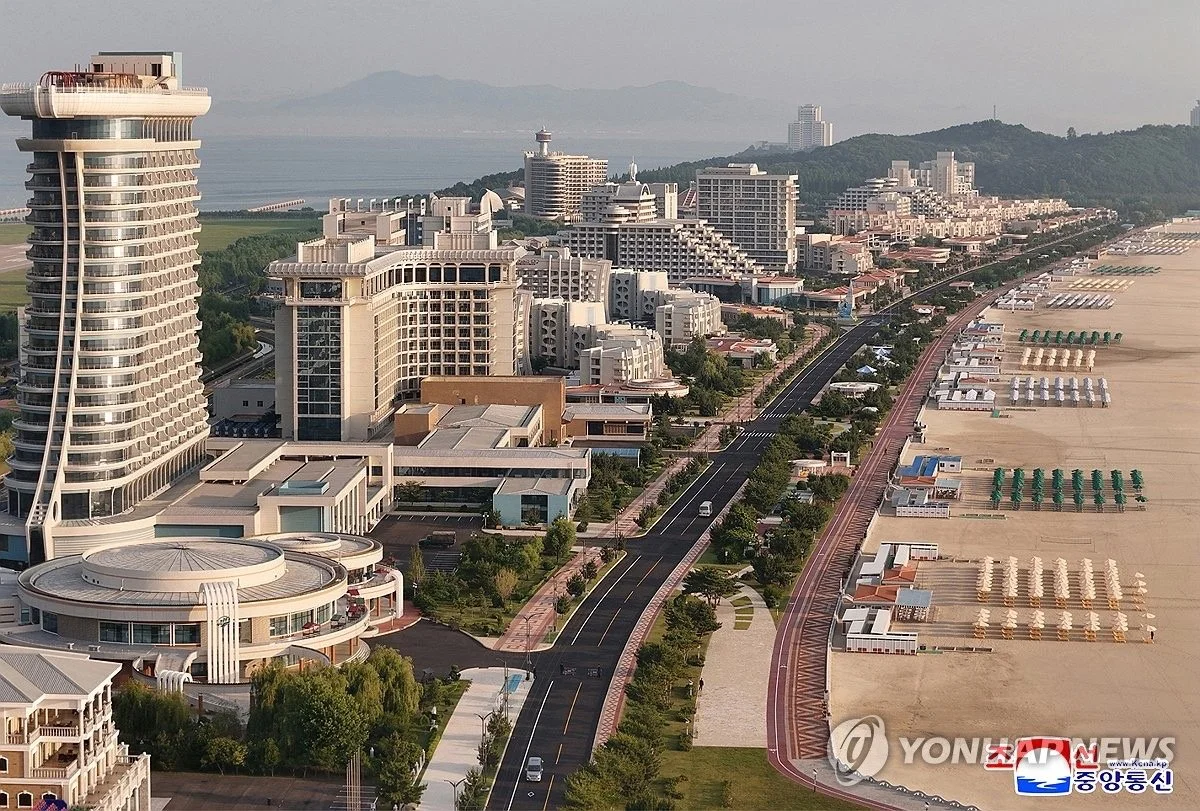
Wonsan-Kalma Beach Resort
Just inland from Wonsan lies one of North Korea’s most well-known leisure developments. Approximately 30 kilometers west of the city, the Masikryong Ski Resort offers ten ski slopes serviced by chairlifts, along with a hotel, ice rink, swimming pool, and restaurants. Opened in 2013, the resort was initially intended primarily for domestic tourists, though a small number of foreign visitors have also accessed the facilities over the years. Our own family had the opportunity to visit Masikryong during travel to and from Wonsan.
Another symbolic step toward reopening has been the revival of the Pyongyang Marathon. Traditionally held each spring, the event previously drew hundreds of foreign runners. During the pandemic, the marathon was suspended, but in 2025 it made a notable return after a six-year hiatus. Hundreds of international participants, primarily through Koryo Tours, joined the race. While participation remained significantly lower than pre-COVID levels, the event marked an important milestone. Koryo Tours has since announced plans to offer participation again in 2026, with race options including the 5K, 10K, half marathon, and full marathon.

Masikryong Ski Resort
Despite these developments, the DPRK has largely remained closed to most foreign nationalities and international tourists. Many humanitarian organizations have not yet been permitted to resume on-the-ground operations, and only a limited number of foreign entities have been allowed to return. In these cases, Russian and Chinese nationals have generally been prioritized over other nationalities.
More recently, however, the northeastern region of Rason has announced that its border is now open five-days a week starting in December 2025. Up until now, People visiting the area from China or abroad could enter or exit primarily only on Mondays or Thursdays.
Rason occupies a unique position within the DPRK, operating semi-independently as a hub designed to attract foreign investment and business activity. Located at the tri-border area where Russia, China, and North Korea meet, the region has historically been more open to foreign investors than even the capital city of Pyongyang. The new year will prove just how much more open Rason might be to foreigners.
It has now been over a year since the DPRK began cautiously reopening its borders to foreign travelers. Known for maintaining some of the world’s most restrictive international tourism policies, the country is nonetheless showing signs of gradually easing COVID-era precautionary measures.
What is evident is that the DPRK continues to reopen in selective and deliberate ways. As access to Rason expands, it is reasonable to expect that other regions may eventually follow, paving the way for broader international engagement and a measured revival of tourism across the country.