Where is “Your Land”?
According to Self-Determination Theory (SDT), every person has three fundamental psychological needs: autonomy, competence, and relatedness. Autonomy is the ability to direct one’s own behavior and goals without external pressure. Competence is the capacity to master skills and accomplish meaningful tasks. Relatedness is the need to feel connected, cared for, and to experience a sense of belonging. Regardless of culture or geography, these three needs are universal.
Yet in today’s world, self-determination has been swept out from under large groups of people. Our world is more mobile than ever before. People travel vast distances in short periods of time, while conflicts, natural disasters, and political persecution drive mass migrations. Whether voluntary or involuntary, migration forces people to adapt to unfamiliar surroundings, navigate new cultures, and assimilate into new ways of life.
Koreans are one group that has experienced migration for well over a century. Beginning in the late 1800s, as foreign powers pressed in on the Korean Peninsula—culminating in the Russo-Japanese War and Japan’s annexation of Korea in 1910—Koreans dispersed throughout Asia. Many freedom fighters resisting Japanese rule sought refuge in China (Manchuria) or Russia. Others were taken to Japan following Korea’s annexation.
Koreans have now lived in Japan for several generations. When Korea gained independence in 1945, approximately two million Koreans resided in Japan. Today, that number has decreased to fewer than one million. During and after the war, Koreans in Japan endured injuries, loss, and discrimination. In the decades following liberation, particularly throughout the 1950s and 1960s, tens of thousands returned to Korea.
Many who remained did not obtain Japanese citizenship. Though granted permanent resident status, they were required to choose between North and South Korean nationality. Initially, more chose North Korean citizenship because the North Korean government provided support for Korean schools and community infrastructure in Japan. Today, however, the number of North Korean citizens in Japan is declining. Approximately 30,000 North Korean citizens remain among roughly 400,000 Koreans who have lived in Japan for generations.
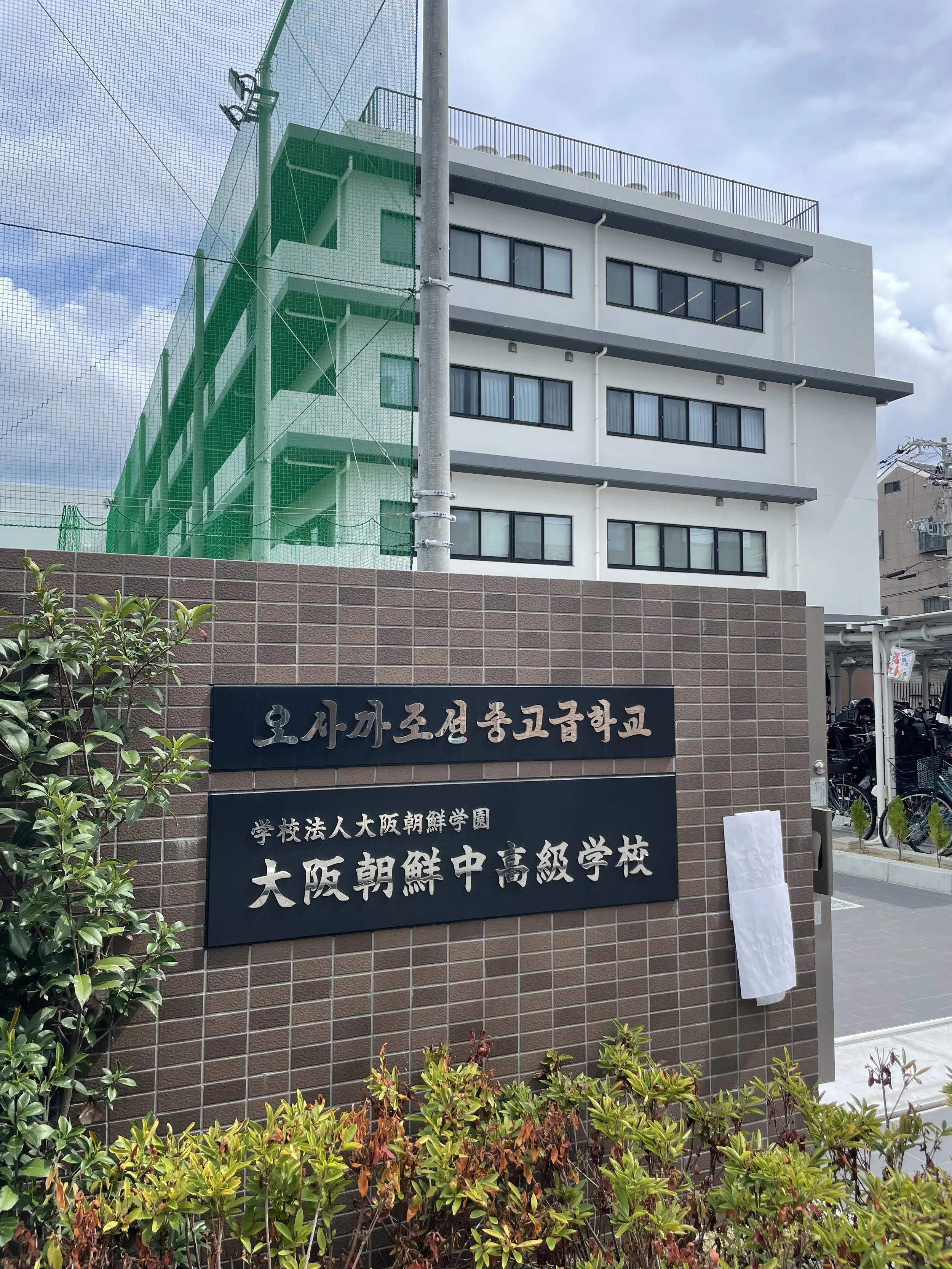
Korean High School in Osaka, Japan
Many are now fourth- or fifth-generation residents. Yet despite generations spent in Japan, they continue to maintain a strong Korean identity. This endurance has been sustained through deep community bonds and a steadfast commitment to educating the next generation.
Their heart for their people is beautifully expressed in the following essay by a student in a Korean school in Japan. It is titled “Where Is ‘Your Land’?”
Dear friends, where is “your land”?
If you were Japanese, you might be able to answer immediately.
But for us Koreans in Japan, it is not such a simple question.
The phrase “your land” comes from one of my favorite sayings that I learned in Korean school: “Keep your feet planted firmly on your land and look out over the world!”
Why do I love this phrase? At first, simply because it sounded inspiring.
But a certain encounter made me reflect more deeply on its true meaning.
That encounter was with people who do not have their own land—refugees.
Last summer, as part of a school activity, I visited an organization that supports refugees. We were nervous at first, but they warmly welcomed us with handmade cakes and drinks. We learned that many had come to Japan because their lives were in danger. Even now, some live without official recognition, fearing deportation and unable to work or receive health insurance. When I discovered that some were around my age, my heart ached.
They shared stories of their hometowns—their songs, their food, their daily lives. At the end, one person said in halting Japanese, “I will not give up being who I am.”
I was deeply moved. It felt as though they were telling us, “Never be ashamed of longing for your homeland. Never give up being who you are.”
In that moment, I realized they were living out the very slogan I admired. Even in a foreign country, they carried their homeland in their hearts. Their identity gave them a place to stand.
As a Korean living in Japan, I have always been conscious of how Japanese society sees me. I often lived as if hiding—afraid to stand confidently on my own land. For the first time, I began to ask myself seriously:
Where is my land?
Summer faded into autumn as I carried that question with me. As a member of the Korean dance club, I devoted myself to preparing for a competition. Our performance centered on the story of first-generation Koreans in Japan. In it, students encounter an elderly woman who shares the struggles of our people’s history.
During the colonial period, after losing their country, our ancestors built small Korean language schools in foreign lands to protect their language, culture, and dignity. Despite countless hardships, they preserved and nurtured these schools for us—the next generation. Our dance expressed our determination to carry that history forward.
The day of the performance finally arrived. In the final scene, symbolizing our resolve, we slowly turned to face the audience. Before us sat members of our community, watching with warm, gentle eyes—as if silently embracing us.
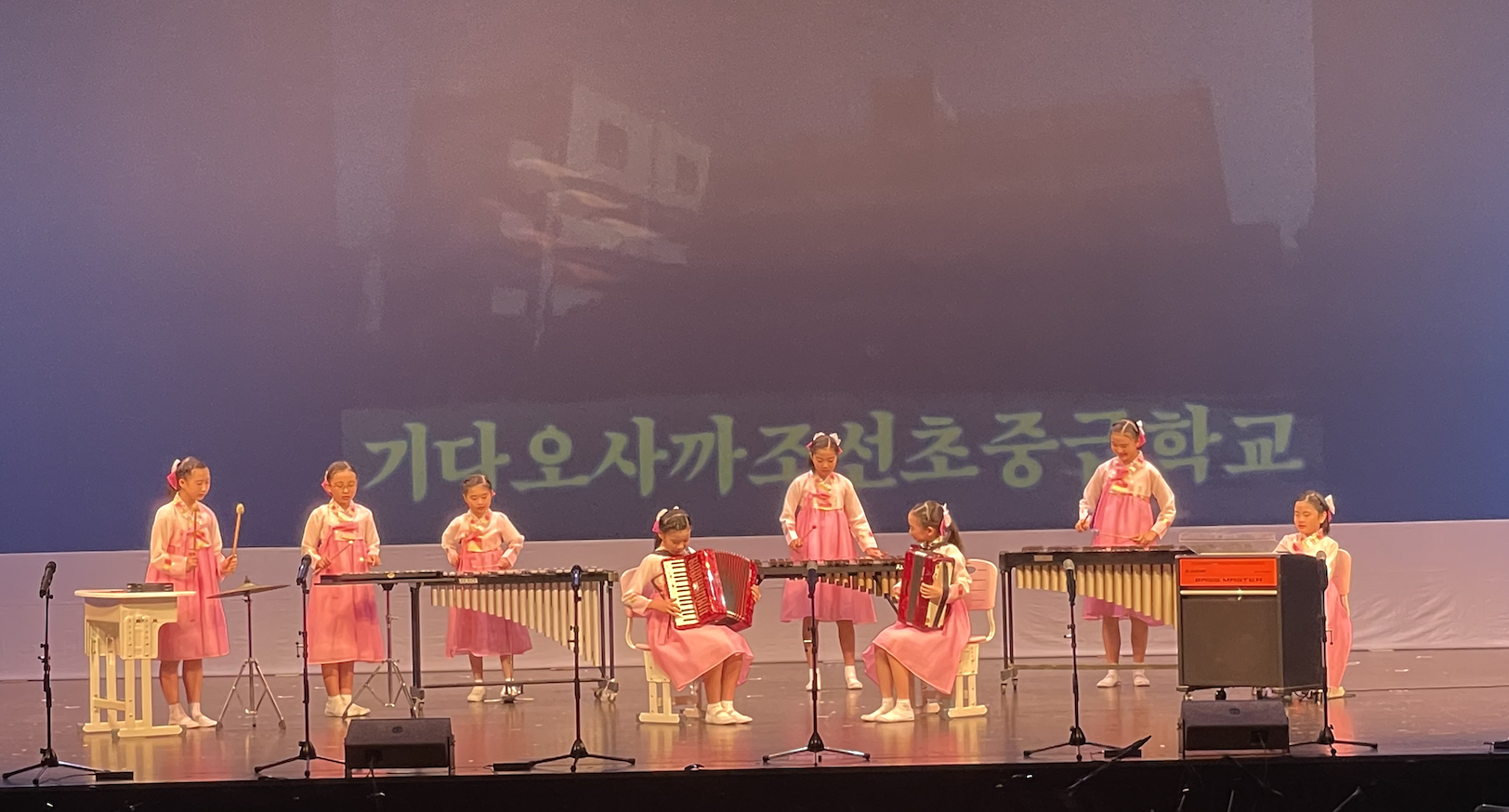
Korean School Performance in Japan
In that instant, my heart overflowed.
As I danced, tears began to fall without my realizing it. And in those tears, I found my answer:
This is my land. This is my place.
Dear friends, where is “your land”?
Through these experiences, I found mine.
My land is the friends who accept me as I am. It is the club activities where we pour out our passion. It is the new school building, carefully constructed by our community so that we could learn and grow together. Everything that shapes who I am—this is my land.
Just as meeting refugees gave me courage, I want to become someone who gives courage to others.
My land. Your land. This school is my land.
This is where I stand.
From here, I will look out over the world.
I will keep my feet planted firmly on my land.
When I first read this essay, it deeply moved me. I, too, grew up overseas, away from my home country. I understand the quiet disorientation of not knowing where you belong or where your roots truly lie. Like many Korean-Japanese youth, I am a third-culture kid—someone who spent a significant part of childhood outside their parents’ culture.
And like this young writer, I have come to realize that “land” is not necessarily a physical place. Land is community. It is the people among whom I can live freely. It is where I am able to grow in autonomy and competence. It is where I belong. Community is my land.
I hope this essay encourages each of us to become that kind of land for others- a welcoming, community where others can fully thrive and find their sense of belonging.