The Impossibility of the Standstill: Finding a Path for Peace
For more than seventy years, the Korean Peninsula has existed in an uncomfortable space between war and peace. The Korean War ended with an armistice in 1953—not a peace treaty—and the unresolved conflict continues to shape the security architecture of Northeast Asia.
The question is no longer simply whether the United States and the Democratic People’s Republic of Korea (DPRK) disagree. They clearly do. The more consequential question is this: How can peace ever be achieved if neither side is willing to take the first meaningful step?
That question has become increasingly urgent since the collapse of the 2019 Hanoi Summit. The summit ended without an agreement despite discussions about sanctions relief, North Korea’s nuclear program, a possible peace declaration, diplomatic liaison offices, and the recovery of American servicemembers’ remains.
The diplomatic process had effectively become a contest over sequencing. Washington maintained that meaningful denuclearization should precede substantial sanctions relief. Pyongyang, meanwhile, sought reciprocal measures—including sanctions relief and changes to what it regarded as hostile U.S. policies—in exchange for steps regarding its nuclear program.
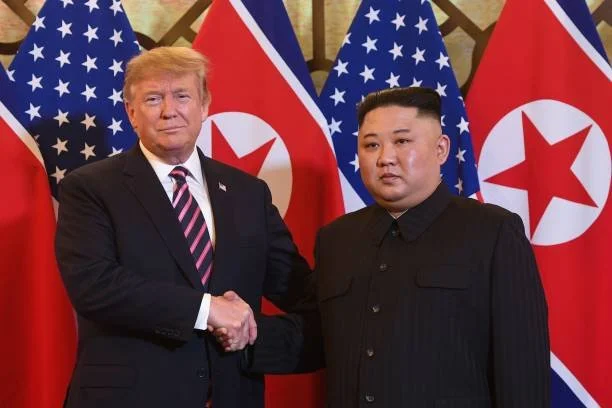
The result has been stalemate. The fundamental problem is that both sides have legitimate security concerns from their own perspectives, yet the measures each takes to address those concerns can make the other side feel less secure.
The United States and South Korea maintain a powerful military alliance and have expanded security cooperation with Japan. The three countries have emphasized trilateral cooperation as an important component of regional stability in response to North Korea’s nuclear and missile programs. From Washington and Seoul’s perspective, deterrence is intended to prevent conflict.
From Pyongyang’s perspective, however, military exercises, U.S. strategic assets, sanctions, and stronger regional alliances can be interpreted as evidence that its security environment is becoming more threatening.
North Korea has responded by strengthening its own strategic relationships. Most significantly, North Korea and Russia signed a Comprehensive Strategic Partnership Treaty in June 2024 that includes provisions for military assistance if either country is attacked, along with broader economic, scientific, technological, and other cooperation.
The result is a security environment in which both sides can describe their actions as defensive while simultaneously contributing to a cycle of increasing confrontation. This is the security dilemma at the heart of the Korean Peninsula.
The Hanoi Summit was important precisely because it demonstrated how difficult the existing negotiating formula had become. The summit produced no agreement, and negotiations broke down over what each side would receive in return for the other’s concessions. The Arms Control Association noted at the time that Hanoi ended without agreement on the next steps toward denuclearization and peacebuilding.
The lesson should not simply be that diplomacy failed. A more important lesson is that the sequencing of diplomacy failed. If one side says, “You must move first,” and the other responds, “No, you must move first,” negotiations can remain frozen indefinitely. That is where the Korean Peninsula finds itself.
There is an uncomfortable truth at the center of this problem: Someone has to make the first move. Peace does not emerge automatically from stalemate. A first step does not have to mean surrender, abandoning national security interests, or accepting the other side’s entire negotiating position.
Instead, a first step can be limited, verifiable, reciprocal, and designed to create the conditions for a second step. That distinction could fundamentally change the diplomatic conversation. Rather than asking, “Which side gives up everything first?” the question becomes: “What is the smallest meaningful step either side can take that gives the other enough confidence to take the next one?”
One potential starting point is humanitarian cooperation. The recovery and identification of American servicemembers who remain missing from the Korean War is an issue that transcends many of the political disagreements between Washington and Pyongyang. For the families of those servicemembers, the issue is not geopolitics. It is personal.
Humanitarian cooperation could therefore become more than an isolated mission. It could serve as a confidence-building measure. A narrowly tailored arrangement involving remains recovery could open a channel of communication without requiring either government to resolve the entire nuclear dispute first.
The same principle could apply to sanctions. Rather than treating sanctions relief as something that can occur only at the end of a complete diplomatic settlement, policymakers could consider whether narrowly defined, verifiable actions could produce narrowly defined forms of relief.
For example, humanitarian cooperation involving the recovery and identification of Korean War remains could be connected to carefully structured exemptions or sanctions relief necessary to facilitate that work.
A more consequential stage could involve a verifiable nuclear freeze. If the DPRK agreed to a meaningful and verifiable limitation on further nuclear development, the United States and its partners could consider corresponding economic or diplomatic measures within the constraints of U.S. and international law.
Such an arrangement would not resolve the broader denuclearization issue. But it could change the direction of the relationship.
The ultimate question is what happens to the Korean War itself. An armistice can stop a war from continuing. It cannot, by itself, create peace.
A permanent peace arrangement would require negotiations over the military, diplomatic, political, and security structures that have existed since 1953. This is where the concept of a liaison office becomes important.
Direct diplomatic communication does not require the United States and North Korea to agree on everything. It provides a mechanism for managing disagreements through communication rather than threats, military demonstrations, or assumptions about the other side’s intentions. A permanent diplomatic channel could provide a means of addressing difficult questions over time.
The Korean Peninsula does not need another cycle in which Washington demands denuclearization before meaningful concessions while Pyongyang demands meaningful concessions before substantial denuclearization. That model has already produced years of deadlock.

A different approach would recognize the realities that exist today: North Korea possesses a significant nuclear capability; U.S.-ROK-Japan security cooperation has expanded; North Korea-Russia cooperation has deepened; sanctions remain extensive; and the Korean War remains technically unresolved.
None of these realities makes peace impossible. But they do make old negotiating assumptions increasingly inadequate.
The objective, therefore, should be neither unconditional accommodation nor indefinite pressure. It should be a structured diplomatic process in which security, nuclear risk reduction, sanctions, humanitarian issues, economic development, military exercises, diplomatic normalization, and a permanent peace arrangement are negotiated together—but implemented in carefully verified stages.
The critical point is that the first step does not have to settle the dispute. It has to change the direction of the dispute.
A square peg cannot fit into a circular hole simply by applying more pressure. The shape of the process has to change. If the stated objective is peace, then diplomacy must be designed to make peace possible.
The Korean Peninsula has already spent generations living with the consequences of an unfinished war. The question now is whether the United States, the DPRK, South Korea, China, Russia, and other relevant actors can develop a process capable of moving beyond the standstill and replacing an armistice with a sustainable peace.
A first step will require courage. But without a first step, there cannot be a second—and without a second step, there can be no path to peace.